Monday, May 22, 2017

River Clean Up Service Project


Image result for papel de caramelo
Being a volunteer is a great opportunity to learn something new while you are helping the community.
Last Saturday morning I attended to a River Clean Up, it is not related to the class of Anatomy and Physiology but it is always good to help the community. 

As soon as we got to the creek they gave us gloves and a bag for pickup all the trash. During the couple of hour that I spent in the river I saw a lot of different types of trash that the people throw to the creek. I picked up a stack of crystals and also we found clothes, wrap of sweets and a pizza box.
We walked by all the creek and while we picked up all these garbage.
There was another thing that made me thinkin do more volunteer hours, the organization told us that they are not used to have that huge amount of volunteers. Basically the people does all these types of activities if it give them something in exchange.

We passed this cave and this explains why there was a pizza box or wrapping of snacks. The people go there for hangout but they don't get responsible of the cleaning.

From this experience I had learn that the environment is super important for our lives and we should take care of it. If we want to have the opportunity of enjoy the nature we should clean it. Seen all this garbage I realize that the people don't take care of their own community and this only affect them and us. 


Monday, May 15, 2017

Unit 8 Reflection

Wednesday, May 3, 2017

Chicken Dissection Analysis


Yellow: Pectoralis major
Blue: Pectoralis minor


The dissection we did the other day in class consisted of observing and comparing the muscles of a chicken with those of humans. The dissection started with the cleaning of the chicken by drying it and the next one was start to peel the skin. After this we open the chicken by the chest and we observe the different muscles that are in that zone, like the pectoralis major and minor. The pectoralis major goes from the keel through the shoulder to the humerus and it pull the wing vertically, and the pectoralis minor lifts the wing dorsally.


Blue: Trapezius
Yellow: Latissimus dorsi


In the upper back of the chicken we found two different main muscles: the trapezius and the latissimus dorsi. The trapezius run perpendicular from the backbone to the shoulder and pulls the shoulder back; in humans they are split into two parts. The latissimus dorsi runs from the spine into the armpit and extend or pull the wing.


Green: Biceps brachii
Blue: Deltoid
Yellow: Triceps humeralis


In the chicken first wing segment we found the biceps brachii that flexes the wing or arm, also the deltoid that is the muscle on the center of the top shoulder and helps to raise the upper arm, and lastly we found the triceps humeralis that extends the wing or arm; in humans this is a muscle used in doing reverse curls.


Green: Brachioradialis
Yellow: Flexor carpi ulnaris


The second wing segment is divided into brachioradialis that is the largest muscle on 
the superior side of the lower wing closest to 
the alula and it pulls the hand back, and also 
the flexor carpi ulnaris that is the largest muscle
 on the posterior side of the lower wing and 
it flexes the hand; in humans this is a primary muscle used in doing wrist curls.


Yellow= Sartorius
Blue= Quadriceps
Black= Iliotibialis
Red= Biceps Femoris
Green= Semitendinosus
White= Semimembranosus


In the chicken thigh we found a lot of different muscles. The sartorius that flexes the thigh and allows crossing of the legs. The iliotibialis is a group muscle that covers the whole lateral side of the thigh and extends it at the time that flexes the leg. The semimembranosus and the semitendinosus only extends the thigh. The quadriceps femoris lies on the inside of the thigh just medial to the sartorius in the bird, it's a group of 4 muscles which flexes the thigh and extends the lower leg. This muscles are used in doing leg extensions in humans.


Red= Gastrocnemius
Yellow= Tibialis anterior
Blue= Peroneus Longus


The chicken's drumstick is divided into the gastrocnemius, the peroneus longus and the tibialis anterior.
The gastrocnemius has two distinct heads in both birds and humans. It extends the foot and flexes the lower leg.
The peroneus longus helps to extend the foot.
The tibialis anterior is large and is directly under the peroneus longus in birds and flexes the foot.


All the muscles are differentiate between the insertion and origin because the intersection of the muscle moves but the origin not.

Friday, March 31, 2017

Owl Pellet Lab

For the Owl Pellet Dissection we basically measured and weight it before start doing anything, after that we started to separate carefully all the different part and taking out the bones for after create the skeleton. After separating all the different types of bones we organize them and analyzing them for start identifying what type of animal could be, after taking pictures and finding the correct type of animal we finished the lab cleaning.
In our pellet we found the bones of a vole:


If you compare the bones of the picture and the ones in the packet you will see that they match, so this show us that it should be it. Also we found the fibula and the tibia who match with the picture, the vertebral column show us that this animal walk because it needed it for support the body. We found smaller bones that could be part of the tail and the scapula bone show us more evidence for finally determinate that it's a vole.


The similarities with the human skeleton are visible in were both skeletons are slightly similar in structure, both have femur, tibia, fibula or humerus. Another similarity is the amount of bones in the extremities like the legs. And the last similarity is that the vertebral column is formed by vertebrae.

The differences are in the size because as is appreciable  the vole is smaller. Other difference is the hardness of the bones, the human are harder because we are bigger than the voles. And the last difference is the fact that the voles have tail bones.

Friday, March 17, 2017

Unit 6 Reflection

This unit was about the nervous system, its organs like the brain and it parts, and the ones related like the eyes. We studied more about the parts of the brain, we did the dissection and see all the specific brain parts, also we read about the functions of the brain and cases where the people was born without some parts, so we learned how their brains need to adjust to work as good as it can. We learned how works the neurons that process the information and create a answer, and the receptors that take the sensations and send them to the brain by the nerves, like in the reading of the training we learned that if you exercise your body and brain, in the future all will work better. Other lab that we did and was connected to the nervous receptors was the "Reflex Lab" where we tested our reactions in front of different situations. Also we learned about the senses and the different types of receptors that each one has like the eye and the photoreceptors, and we did the dissection for see all the parts inside the eye.
During this unit we had about 5 reading where we learned more about the information that we had in our notes and vodcasts. The first was"The Woman with a Whole in the Brain"where we learned about a woman that life 20 years without knowing that she was missing¡g a part of her brain, but her brain adjust to make all the basic functions. After "A woman perpetually falling" where I learned more about the bad connections between learned in the brain and the parts of the body, after this one came " How to became a Superager" where I learned more about the fact that if old people have an active their brains are more active too so their functions continuing working. "Fit Body, Fit Brain and Other Fitness Tends" talks about the importance of exercise for the good functioning of the brain. And lastly "How we get addicted" talks about the problems that some people have when they get addicted to some substances and they can't stop consuming it. 

This unit was more hard that I really thought that it will be but the fact that the brain is connected to a lot of different parts of the body makes it a long and hard unit. Maybe I should have done the readings with more attention because I only got the basic information of each one. And the fact that a lot of new vocabulary appeared for me made it harder.

I would like to expand more information inside each of the diseases and also watch more videos than read, because in my personal opinion when you hear a video you understand the information better than when you are reading.

During this unit I didn't really make my goals because in the other subject the time of working started to be longer so I leave the daily review.

Thursday, March 16, 2017

Reflexes Lab

In this Lab we were testing the reactions of our body in different situations. During the readings I was learning a lot but when you really experience it you realize easier how our body works. A reflex is the reaction that our body does for try to decrease our danger, your pupil dilates depending the light that you need in each moment or the eyes closed when something is going to go into them.
The Photopupillary Reflex  help to control the amount of light that our eyes need, so when you are in a dark place and a light comes to your eye, the pupil change so you receive the right amount of light.
The Knee Jerk Reflex is controlled by mechanoreceptors that help us when we need to react to some situation by moving our body and the muscles fast.
The Blink Reflex help us to avoid getting anything into our eyes.
Babe, what's your sign? is the test of the foot from the sole of it to the heel helps to check the working of the nervous system and to detect any future disease.
How Fast are You? is a test where you need to catch a ruler and depending the distance it tells you how fast does your body react in current situations, after we made the same test while texting and this tries to show that our brain works slower when it needs to send several information at the same time. When I was waiting for the ruler my reaction was of 0.2 seconds but while I was texting it almost duplicate, this show as why they say that we should not drive while been distracted with the phone.


Friday, March 10, 2017

Brain Dissection Analisys

1.


2.
Cerebrum: Integration, sorts data
Cerebellum: Body control, motion memory
Brainstem: Breathing, circulation, digestion

3.
The myelin is a buffle of electrical signals, and it protects the brain

4.

5.
Thalamus: Sorts data
Optic Nerve: Send light signals from the eye to the brain
Medulla Oblongata: Controls digestion
Pons: Blood circulation
Midbrain: Digestion
Corpus Callosum: Sends information between both hemispheres
Hypothalamus: Homeostasis

6.


RELATE & REVIEW

The Brain dissection was easy to perform because the cuts where simple and the instructions were very clear. At the first when I saw the specimen it looked like a piece of flesh, beige in color with ridges and depressions. I could clearly identify and see the cerebrum because is a major part, below it was the cerebellum that was also clear, the posterior end was the brainstem.
Inside the brain upon cutting the flesh looked clear and clean.
I learned that the biggest part of the brain is the Cerebrum which is so important in higher brain functions like thought and action.


Wednesday, March 8, 2017

Sheep Eye Dissection Analysis

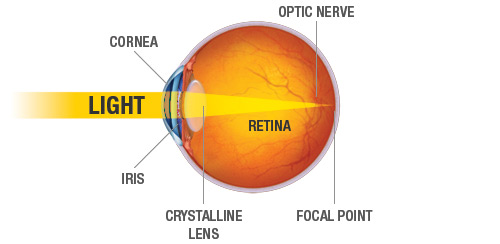
The light goes through the eye in the following order: Cornea, Aqueous Humor, Pupil, Lens, Vitreous Humus, Retina, Optic Nerve and finally the Brain.

Cornea, first layer of the eye and bends the light, after goes by the Aqueous Humor; the Pupil ,opening in the Iris where the light goes into the eye; the Lens,that change shape to focus light on the retina; the Vitreous Humor, this extra component helps to give shape to the eye; the Retina,where are found the photoreceptors for vision and the Optic Nerve finally send this information to the brain where is transform to images.


Tuesday, March 7, 2017

A Woman Perpetually Falling ...

"Cheryl's problem is that her vestibular apparatus, the sensory organ for the balance system isn't working"
       - This woman can't stay stand because the part four of our body that is responsible for the balance of our body is not working.

"We are now working on getting this device small enough so that it is hidden in the mouth" 
       - They created a device that send the movement to your brain so it can react sending movements for prevent falling.

"How is it that Cheryl can dance and has returned to normal functioning without the machine?"
      - The machine helps to reinforce the signals from the healthy tissues, so her brain is starting to work again slowly.

* A woman that lost her vestibular apparatus that gives us the balance, is subjected to a new experiment that maybe improve or change her life, a helmet that sends to the brain the signals that our vestibular apparatus would do, so she can stay up strong without feeling dizzy and having balance.*

Sunday, February 12, 2017

The Clay Brain

During the past class we were doing two models of the human brain. We divided the brain in the different parts and we differentiated them with different clay colors. Later we indicate which color represented each part and finally we made sure that all the different parts were good indicated.


Wednesday, February 8, 2017

"The Woman With a Hole in Her Brain"

This article talks about a woman that basically had lived during 24 years with our Cerebellum, organ that have 50 % of the total of nerves of the brain. She started talking when she was 6 years and to walk when she was 7. The doctors where impressed because the other cases that were know were discovered in the autopsy, this people die when they are so young. Related to the subject of Anatomy & Physiology we can learn that the Cerebellum is responsible of the body control, voluntary movements and balance. But this girl talked and walked, the doctor said that the explanation for that was that maybe the cerebral cortex have been taken over this.

Midbrain: Imagine that a person have missed or severely damaged this structure, what would they not be able to do? Could they survive without it? Could other parts of the brain take over? 
The Midbrain is responsible for transfer visual & auditory input to the brain and motor information from the brain. It is located in the brainstem, between forebrain and hindbrain. 
So basically any person would not be able to see or move if no-one of the other structures could helping the transfer of the information. I think that they could survive but with all their lives without moving. Maybe other parts of the brain could help like the ones that are involved in processing information.


Thursday, February 2, 2017

Unit 5 Reflection

Wednesday, February 1, 2017

Why do we have stomach pain?

Some reasons for stomach pain are Infections, Constipation, Irritation and Inflammation and other like Acid reflux, Food allergies and Reproductive/Anatomical problems or Emotional Distress. When Infections occur due to Bacterial usually are from food poisoning. Viruses like stomach flu can also be another cause spread from person to person. When you don't have a right diet with fiber and enough fluids your stomach works bad and give pain. Appendicitis is an inflammation of a internal organ that also can give us stomach pain. When people get stressed out, depressed or anxious, their emotions can trigger physical symptoms, such as stomach pain.
This topic is related to the class of Anatomy because we are studying the digestive system and I wanted to search more information about "Why do we have stomach pain?", all the people have experience some stomach pain, so I also thought that was an interesting topic to search about.
I had learn a lot by searching for more information.

Wednesday, January 18, 2017

The Digestive System Lab

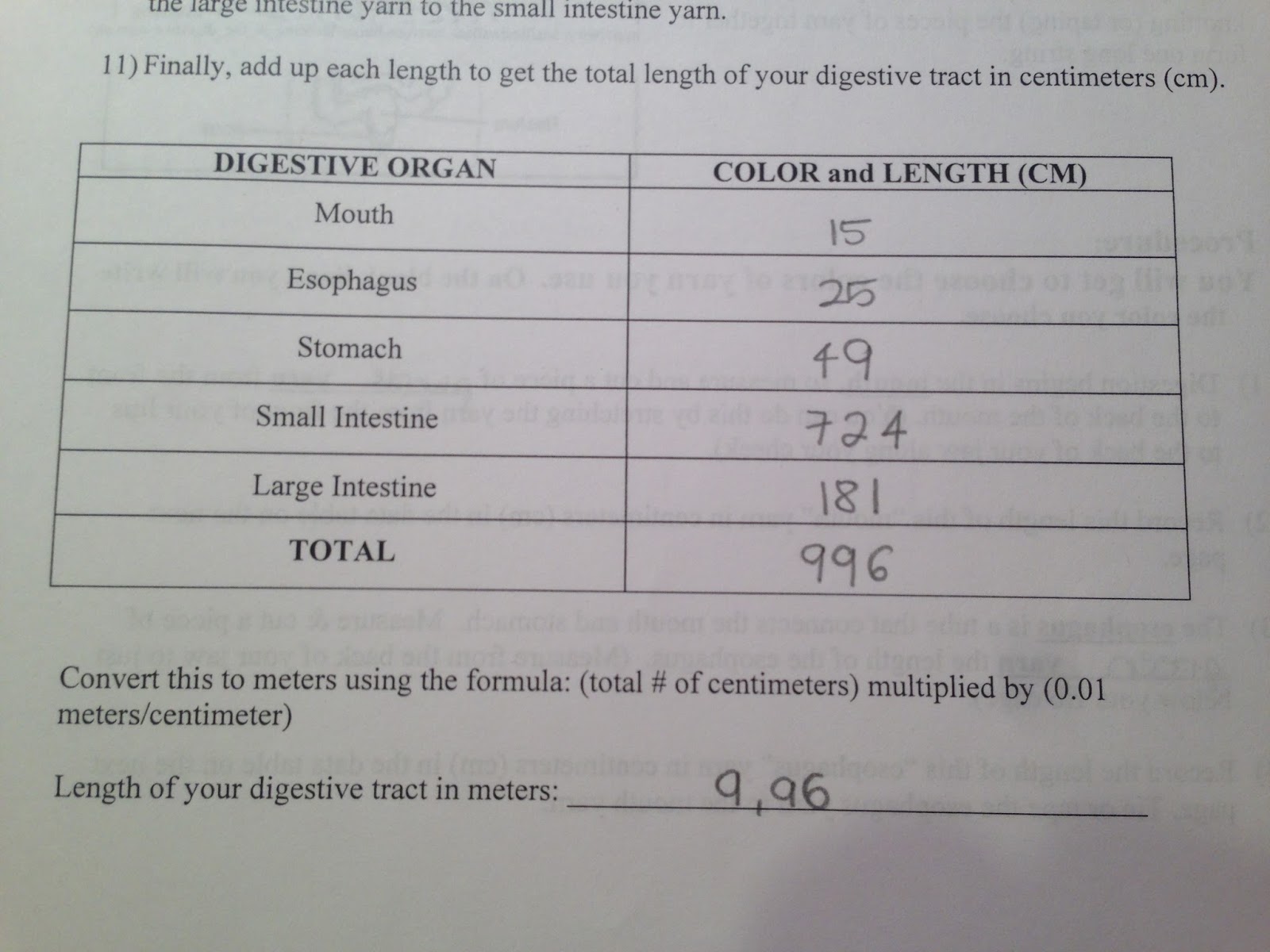
During this lab we measured the length of our entire digestive system. For make it we took different length and color yarns and cut them by the right mesure for each of us. The fist step was to measure the mouth, the esophagus, the stomach, and both intestines and cut the yarns. When we had all we measured them in cm and right all this number in the data table. When we had all the yarns we tied them and took a photo of the real length of the digestive system. 


I had learn and realize how big is the digestive system, and I understood better how our body process the food.
The digestive system is able to fit inside the body because is bent several times, and is all together. The food spend an average of 53 hours to go through the entire digestive system, but I thought that was less, about 30 hours. The time that the food spend inside the large intestine is bigger that the one that I thought, and also depends the type of diet that you eat will be easier or harder to digest. The digestion is the breaking down the food in small pieces and the absorption is taking the nutrients, water, etc. needed. The organs hat are involved are the stomach, the small intestine and the large intestine.
I would like learn why do we barf when we are sick.


Monday, January 9, 2017

New Year Goals

During the break I've been thinking about my goals for this 2017 year, one of them is focussing more in my studies and improving my grades in general, my future depends on the grades I will achieve during the actual year and the next one, therefore I will have to spend more time reviewing and working on the staff we learn in class and don't leave it to the week before the test. I think that now that I have improved a little bite more my English skills I will be able to understand better all my teachers explanations than before and it will be also easier and much more enjoyable to study. In fact I feel very lucky because I really like the subjects I'm taking now, and that's another reason why it won't be difficult for me to get interest on them!
My other goals for this 2017 are to waste less money in unnecessary things and instead donate that money to charity; and to participate in more volunteer activities or projects. Two years ago I participated in community activities like caring for elderly people, or going to schools to help socially disadvantaged children to do their homework. Through this volunteer activities I realized how lucky I am with all I have, and how much I want to continue helping others that aren't as lucky as me. 
Finally my last resolution so far is to make the most of my second semester in the USA, keep learning and experience USA´s culture, enjoy each tradition and learn as much as possible form this great country to become in the future a good ambassador of the USA, giving this country and its people back all what you have been giving to me during my stay in here.

Wednesday, December 7, 2016

Wellness Day Reflection

My Google Presentation link: https://docs.google.com/presentation/d/1nA77gFS9R_cytVUAa0o9x0WVBw3blZlSEpjf1pP1Kxs/edit?usp=sharing


I chose the topic of massages because when I was little, I found massage amazing and I was interested in it. When I realized that I had an opportunity to learn more about it I suggested massage as our topic to my project partner. In the future, I would like to study something related to medicine but more in the way of massages or holistic health or maybe physical therapy. I think the benefits of working with massage and healing would be very rewarding.


One of the most amazing things that I learned while preparing this presentation was that there are many different types of massage. All types of massage have similar benefits, related to relaxation and whole body health. The last thing that I found interesting is all the different techniques are applied depending on the type of injuries in the case of sports massage.

During my life, I have heard a lot of people telling me that massage is good for your health and now that I have learned more about the subject of Anatomy & Physiology, I realized that it also helps in wellness and holistic health. Massage does this by decreasing the stress related with insomnia. Another benefit is that massage relaxes the entire body and helps athletes recover from sports injuries. Massage can also help with digestive disorders and reduces anxiety. I found this very interesting.

On a scale of 1 to 10, I would grade myself with an 8.5 because I worked a lot on this project and also I found good information about it. But if I would have the opportunity to repeat this project, I would add more practical information and I would make it more interactive by getting the audience to participate in more sample massages.

Becoming a massage therapist  takes professional training and there are many programs in the area. The basic certificate takes 500 hours from an approved school. There is a test that massage therapists must pass called The Federation of State Massage Therapy Boards (FSMTB) and the Massage & Bodywork Licensing Examination (MBLEx). These tests are regulated by the state of California. 

So in a few years if I'm still interested I would like to came back to the United States of America to study in an approved school and take this test. The more skills, degrees and certificates, the better change I have of obtaining a good job abroad my home country.

Sunday, December 4, 2016

Unit 4 Reflexion

This unit was about the integumentary system. Also, it´s about the structure of the skin which is divided into the epidermis,the shallow layer, and the dermis, the deep layer, and how these layers are affected after a burn; about cancer, with the different varieties and how it grows. Also in this unit, we learned about why we get sick and what is happening inside us and the resistances of our body. Also, I learned that when I am with different groups people I work differently.

The concepts of this unit that I thought were the most difficult were the different types of glands of the body because I always mixed up the different characteristics with the different names.

I learned a lot of new staff about the mechanism of our body, why we have temperature, why burns hurt, and also why skin tans when we sunbath.

From the debate I learned that sometimes in your life you need to work with people who have different ideas than you, and a lot of times you will need to agree with them because your livelihood depends on it (you have your keep your job), and also that sometimes you will work with people who you may disagree with. Finally, I leaned how to study better, like being with a friend because you help each other.


Heart Dissection Lab


1. The pericardium is the outer most layer of the heart, it´s purpose is hold the heart and prevent that it broken when all the pressure of the blood goes inside the heart. It consists of an outer fibrous layer and a inner double layer of serous membrane.

2. The arteries looked larger than the veins. The arteries are more muscular and have more elasticity than the veins, and the veins have valves to prevent the back flow of blood. 

3. The auricle is an extra each to hold the blood. The function of the auricle is to increase the capacity of the atrium and the volume of blood it can contain.

4. The ventricle is bigger and thicker than the auricle because the ventricle pump out blood from the heart. The atria receive blood from the veins so they are thinner.

5. a.Exit from the coronary sinus; empties into the right atrium (smaller side) 
b. Exit from the inferior vena cava; on the flap on the right posterior side
c. Tricuspid valve; white ring between right atrium and ventricle and has three  visible flaps


6. Picture of tricuspid valve, chordate tendon, papillary muscle
        
6

7. The "anchoring" of the heart valves by the chordate tendon and papillary muscles is important because they serve as wires and help connect the cusps. 

8. We can see the bicuspid valve that looks as opaque pouch and is connected to the chordate tendinae and has two flaps.

9. The function of the semi-lunar valve is to make sure that there is no back flow between the atrium and the ventricle.

10. a.The blood is not able to be pushed to the heart so it would cause swelling in the ankles and feet.
b. Different parts of the body would be oxygen-deprived and the blood would be unable to delivered to every part of the body.

11. The bicuspid valve looks like a pouch that intertwines with the chordate tendinae. The chordate tendinae are attached to the papillary muscles and look like stringy fibers tissue.

12. The left side has a thicker myocardium surrounding it. The right side receive blood from the rest of the body and the left side with the lungs.


13.


Wednesday, October 19, 2016

Heart Chalk Walk

The blood when passes by the heart enter by the superior and inferior vena cava, going into the right atrium, passing by the tricuspid valve and in the right ventricle is pushed up until the pulmonary arteries, and this one send the blood to the lamb where the blood will be oxygenated. Then the blood return by the pulmonary veins, going into the left atrium and then passes by the mitral or bicuspid valve, finally goes to the aorta that distributed the blood by the rest of the body, to the legs and arms by the descending aorta.


Tuesday, October 11, 2016

Unit 2: Reflection : Health


For me Health is the vital balance between Nutrition, Sleep, Stress, Exercise and Social life; if one of the above irregular all the body is unbalanced.
I'm healthy in some facts like exercise, I'm used to do a lot of exercise since I was little so is part of my usually routine.Inside the school I think that there is people healthy and other ones who have an unhealthy life. Maybe for promote a healthier life they can Tell all the students that is so important to sleep 9 hours for give time to your brain for keep the information.
I had learn a lot of specific things like that is super important to have a healthy nutrition, to sleep a lot of hours, the different types of hormones that work in our baby and what they do in each place of the body.
I don't finish to understand why we wake up when we have a nightmare.
In the next unit I will ask more questions about all my questions and I will try to understand all the content.
The day when I learn in class how important is have a social life I realize that it is true, when you spend time with people you are happier so your life is funniest so I decided to stay less time watching TV or staying with the smartphone and talk with my grandparents more time, play with my host brother and use my time to be outside home.